How 2025’s Web Development Trends Are Changing the Digital Experience
October 14, 2025
Artificial intelligence (AI) and machine learning (ML), which turn static websites into dynamic, flexible platforms, are increasingly major components of modern web development. What used to be mostly a manual process is now driven by data and intelligent algorithms. Actually, “the way websites are conceived, designed, developed, and maintained is being revolutionized” by AI/ML. By 2026, AI assistants have evolved from practical instruments to engaged development collaborators, creating new opportunities for productivity and creativity.
The following are some of the primary impacts of AI/ML on web development:
- Automated design and coding: AI can generate complete functions from descriptions, prototype layouts, and even small pieces of code in a few minutes.
- Personalized user experiences: Websites dynamically change their design, information, and recommendations based on user activity.
- Intelligent testing and performance: Machine learning automates real-time performance optimization and testing (visual regression, test-case generation).
- Content and SEO optimization: AI systems continuously refine SEO strategy and produce and enhance content (meta tags, alt text, copy).
- Enhanced security: AI-driven monitoring automatically identifies threats, fixes vulnerabilities, and enforces privacy laws.
These characteristics work together to power the next-generation web’s intelligence, adaptability, and user-centeredness. Below, we look at how AI and ML are transforming each stage of web development.
AI-Powered Coding and Development Tools
These days, developers work together with AI coding support to finish tedious tasks. These days, tools like Amazon CodeWhisperer, GitHub Copilot, and open-source models may generate entire functions from natural language prompts, construct test cases, and suggest code completions. For example:
- Natural language to code: When you describe a feature, the AI creates the appropriate code block.
- Refactoring and auto-completion: AI can identify patterns in your code to automatically complete complex computations and offer suggestions for improvements.
- Test generation: Tools can automatically create relevant unit tests and analyze code changes to guarantee comprehensive coverage.
- Rapid prototyping: AI-driven builders (like Wix ADI or Bookmark) may produce a working website in a few minutes by looking at a business description.
Development is accelerated by these skills. According to one study, ML can “automate routine stages (such as code generation and testing),” which can lead to shorter development cycles. Developers can focus on higher-level design while AI handles boilerplate code. Teams report that by eliminating tedious tasks, AI expedites the idea-to-launch process.
Intelligent UI/UX & Personalization
AI is making user interfaces more dynamic and personalized. Unlike static pages, modern websites are dynamic, reacting to each visitor in real time. For example:

- Adaptive web design systems are AI-powered design tools that can change layouts, color schemes, and fonts on their own based on user behavior, accessibility standards, and brand rules. By gradually learning from interactions, these systems improve the interface over time.
- Information Personalization: Based on on-site behavior (clicks, scrolling, and histories), machine learning algorithms instantaneously personalize information. While a news website can suggest articles based on the pages a user has viewed, an e-commerce website might highlight products that consumers have expressed interest in. User engagement is maintained and conversions are increased by these “in-browser” recommendation systems. According to one report, AI and ML can help websites adapt their content, recommendations, and even interface design to a user’s preferences.
- AI-powered predictive user experience (UX) can change user interface components or load material before a user even clicks. For instance, if analytics show that a visitor usually finishes the checkout process after viewing product details, the website might preload the cart page in the background.
- Voice and Accessibility: AI also powers accessibility features. On-site search can understand natural language queries, voice assistants can browse information using speech, and automatic picture recognition can provide alt text for images. Websites are becoming more inclusive and future-proof as voice search gains popularity.
In a nutshell, AI makes it easier to give one-on-one experiences on a large scale. Instead of a “one-size-fits-all” website, each visitor sees one that is customized for them, which boosts engagement and SEO signals (dwell time, click-through rates, etc.).
Automated Testing & DevOps Enhancements
AI is also being utilized to enhance quality assurance and deployment pipelines. Machine learning is making testing more proactive:
- Visual Regression Testing: By automatically comparing site renderings across browsers and devices, AI systems may identify visual defects that elude human examination.
- Intelligent Test Generation: By analyzing code modifications, AI is able to automatically generate test cases that cover new functionality. This ensures less QA overhead and more thorough testing.
- Performance Monitoring: AI agents continuously monitor performance metrics (such load times and server response) and automatically modify the system. They may, for example, adjust caching strategies, improve database queries, or proactively scale resources to prevent slowdowns.
- CI/CD Automation: Machine learning can be used to automatically check pull requests for errors or style issues. To find potential issues before merging, CI pipelines use tools like CodeQL or custom ML models.
These AI-driven processes preserve the functioning of webpages and spot issues early. By automating time-consuming QA tasks, teams can deploy changes more reliably and frequently.
AI-Driven Content Creation and SEO
AI is changing the content approach as well. Machine learning methods increase productivity in anything from writing to optimization:
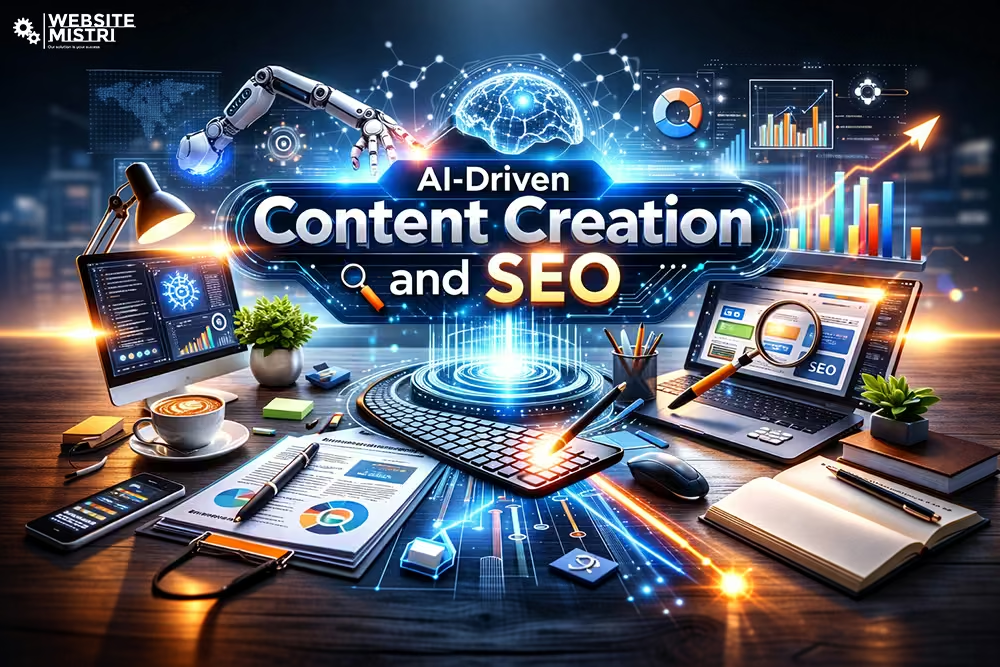
- Automated Content Optimization: AI is able to evaluate the performance of current content (engagement, keywords, bounce rates) and make recommendations for enhancements. In accordance with proper SEO practices, it may even automatically generate alt text, meta descriptions, and structured data (schema markup). This guarantees that every page is completely search engine optimized without the need for manual labor.
- Dynamic Content Generation: Sophisticated AI models are able to create FAQs, blog entries, product descriptions, and ad content that is tailored to your preferences. They create pertinent, on-brand content in a matter of seconds by utilizing context (such as user intent and popular subjects).
- SEO Intelligence: Machine learning forecasts search trends and voice searches. An AI can recognize a fresh keyword trend and recommend updating some pages. It also helps with voice search optimization by providing query suggestions and conversational language. As Google’s own algorithms get more sophisticated, AI solutions help websites adapt to changing ranking factors.
Ultimately, AI improves your content team. It even detects gaps and automates small changes (“you don’t have a page on topic X”). This suggests that far less manual work is required to maintain a website’s authority, freshness, and optimization.
Backend & Cloud AI Integration
AI/ML services are evolving into server-side plug-and-play components. Custom models or APIs are used by web programs to integrate pre-built Cloud AI:
- APIs for AI: AI services from well-known cloud providers like AWS, Google, and Azure are directly available to developers. For example, Amazon Polly converts text to speech (for voice interfaces), Amazon Lex provides chatbot/NLP capabilities, Amazon Rekognition can analyze user-uploaded pictures (identifying text or objects), and Amazon Comprehend handles text sentiment and keyword extraction. With these APIs, teams can easily add intelligence without having a lot of ML experience.
- Custom ML Models: For particular uses, developers train their own models (for example, with PyTorch or TensorFlow). These can run on the server (for instance, with Google Vertex AI or AWS SageMaker) or in the browser (with TensorFlow.js). Custom models allow for complete control and domain-specific capabilities. A website may use a custom recommender model that has been trained on its own data or a fraud-detection model for online store checkout.
- Serverless AI: With serverless features and edge computing, even complex machine learning applications may grow. For instance, a function that is triggered upon a new user’s registration may contact a serverless machine learning model to classify the user’s profile in real-time.
Behind the scenes, developers improve websites by utilizing these backend AI services. With little code work, this increases functionality (voice interfaces, image search, security screening). Although managing third-party dependencies and expenses is a trade-off, for many applications, the advantages greatly exceed the drawbacks.
Performance Optimization with AI
Web performance, or responsiveness and speed, is crucial for SEO and UX. AI contributes in two main ways:
- Automated optimization: Some tools employ AI to optimize resources. AI, for example, can compress images (choosing the optimal formats and resolutions), optimize CSS and JS, and produce responsive picture sets. Services like Cloudflare Image Resizing use machine learning (ML) to deliver the best possible image variation.
- Real-time tuning: As mentioned before, AI can make automatic adjustments in response to performance indicators. If a website loads slowly, the system may lazy-load certain resources, offload time-consuming operations, or reroute queries to faster servers. These AI improvements immediately improve search engine results because Google’s Core Web Vitals criteria punish slow websites (which were changed in 2025).
In a nutshell, AI makes websites fast. “Speed isn’t optional, it’s survival in 2026,” one analyst said.By using AI-powered solutions for caching, code minification, and image compression, businesses can meet strict performance requirements and sustain traffic.
Security and Monitoring
AI excels in cybersecurity as well. In huge datasets, machine learning approaches excel in identifying anomalies:
- Threat Detection: AI-powered security systems continuously examine user behavior and traffic trends. Compared to rule-based systems, they can identify malware, DDoS attacks, and bots more quickly. An ML model might, for instance, identify a little alteration in access patterns and mark it as a possible breach.
- Vulnerability Scanning: AI systems are able to look for known mistakes in code or dependencies from third parties. They recommend patches (usually auto-applying upgrades) based on their knowledge of previous exploits. By proactively fixing security flaws, hackers are prevented from taking use of them.
- Privacy and Compliance: AI helps automate consent management and data anonymization in compliance with regulations such as GDPR. ML monitors the use of user data to ensure compliance by design. Sensitive information may be redacted or administrators may be notified when data processing departs from policy.
These security enhancements lead to more resilient websites. AI can learn from every experience and respond quickly, for example, by blocking a suspicious login. AI-powered security “detect[s] and prevent[s] suspicious activities, bot traffic, and potential breaches,” according to experts, progressively bolstering its defenses.
Benefits for Businesses and Developers
The combined effect of AI/ML is faster development, better UX, and improved ROI:

- Faster Time-to-Market: Tools that offer design or code snippets drastically reduce development time. One evaluation claims that machine learning can “enhance flexibility, reduce development time, and increase the reliability” of web applications. Even tiny firms may produce a sophisticated website in a few hours as opposed to weeks.
- Higher Conversion Rates: Users can find what they’re seeking for more quickly thanks to intelligent interfaces and tailored information, which raises conversion rates. Engaged users are more inclined to spend more time on the website, make purchases, or subscribe.
- Data-Driven Insights: Real-time AI analytics let you see what is and is not functioning properly on your website. This data-driven strategy enables businesses to swiftly iterate and stay ahead of trends.
- Cost-effectiveness: Automating programming, testing, and content reduces the need for large staff. AI-assisted technologies often pay for themselves since they eliminate repetitive work.
- Competitive Edge: Perhaps most importantly, AI levels the playing field. AI has become “the great equalizer, enabling small teams to compete with large corporations,” according to one report, by automating procedures and fostering innovation.
Additionally, the developers benefit. By assigning the tiresome task to others, they may focus on strategy and creativity. The function of a developer is evolving from “code writer” to “AI collaborator.” This means upskilling (learning prompt engineering, evaluating AI output) and creating more ambitious, user-centered digital experiences.
Challenges and Considerations
Despite its advantages, adopting AI/ML in web development comes with challenges:
- Data privacy and ethics: AI often requires data. Ensuring the secure and ethical management of user data is essential. Bias in training data (e.g., customization algorithms favoring specific users) can cause models to become prejudiced. Companies must monitor AI decisions and be open and honest.
- Initial Investment: Especially when using custom models, incorporating AI may involve time and financial upfront costs. Third-party AI services may be subject to use fees.
- Reliability: AI-generated code must be analyzed. Poorly understood “black-box” solutions could make maintenance more challenging. Teams need to balance AI output with good coding practices.
- Skill Shift: Teams must learn how to use AI tools effectively. This means creating clear instructions and confirming AI suggestions. New technologies need to be learned, and the function of a developer is evolving.
- Dependency on External Parties: Using cloud AI necessitates relying on external APIs. Outages or changes to terms or fees may have an impact on your website.
But these challenges are surmountable with careful planning. The key is to use AI to enhance human knowledge rather than to replace it. By putting data ethics first and including humans in the process (code reviews, oversight), organizations may safely benefit from AI.
The Future of Web Development
Looking ahead, the web development landscape will become even more AI-first:
- Autonomous Websites: We may see websites that optimize and update themselves in real time with minimal human intervention.
- Interfaces with Emotion Awareness: Future AI models might be able to understand a user’s tone or facial expressions and adjust the content’s arrangement or tone accordingly.
- Collaborative AI Systems: Rather of a single AI assistant, anticipate ecosystems of specialized AI agents that work together (one for design, one for testing, and one for analytics).
- Evolution of Low-Code/No-Code: AI will allow no-code platforms to create incredibly complex applications with simple inputs. Just describing an app in plain English could soon result in a fully functional prototype.
- Edge AI & Privacy: On-device machine learning (ML), which operates in the browser or on edge servers, will alleviate privacy concerns by allowing intelligent features without moving data to the cloud.
In essence, the web is becoming more intelligent and adaptable. “The future of web development is here, and it’s intelligent, adaptive, and infinitely creative,” says DigitalArts.
Conclusion
AI and machine intelligence are significantly changing the web development industry. AI is being utilized to enhance many aspects of website development and administration, from code automation to user experience personalization. These technologies are more than just flashy add-ons; they are the foundation of the digital experiences of the future.
By incorporating AI into web development, companies may boost customer interaction, stay ahead of the competition, and launch websites faster. Developers will be able to work more creatively while AI handles tedious tasks. According to one expert, AI is boosting human creativity and enabling us to produce more ambitious, user-centered digital experiences than in the past.
The change is already taking place. The most intelligent and prosperous websites in 2026 and beyond will be those that use AI and ML as design and development collaborators rather than only as tools.